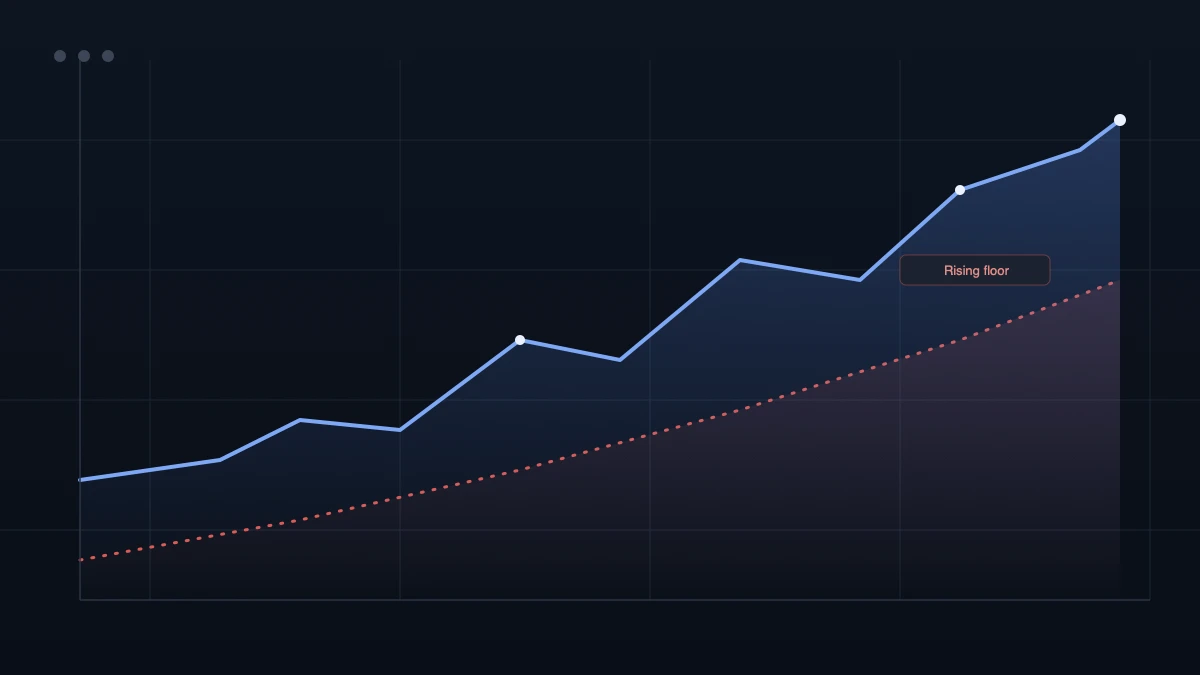
Your account peaks at $108,400 on Tuesday afternoon, then gives back $1,100 into the close. You're still up $8,400 on the week. You feel fine. Then you check the dashboard and realize your trailing drawdown floor just moved up with that peak—and your remaining cushion is $600 less than you thought. That's the moment most traders finally understand what a trailing drawdown actually does.
What Is a Trailing Drawdown?
A trailing drawdown is a loss limit that follows your highest account value upward but never moves back down. Unlike a fixed or static drawdown—where the floor is set once at account open and stays there regardless of performance—a trailing floor creeps up every time your balance or equity hits a new high.
The practical consequence: the better you trade early on, the less absolute room you have later. If you start a $100,000 account with a $5,000 trailing drawdown and run it up to $110,000, your floor is now $105,000. You haven't "banked" that $10,000 gain in terms of safety margin. You've essentially shrunk your cushion back toward zero.
Prop firms use trailing drawdowns precisely because they limit their maximum exposure to any single trader. From a business standpoint it makes sense. From a trader's standpoint it creates a constraint that can feel punishing even when you're doing everything right.
How the Floor Actually Moves—and What Triggers It
This is where traders get burned by the fine print. There are at least three meaningfully different implementations in the wild right now, and they are not interchangeable.
Balance-trailing: The floor only moves when a trade closes at a new high balance. Open floating profit does not move the floor. This is the most trader-friendly version because your unrealized gains don't tighten the rope.
Equity-trailing (intraday trailing drawdown): The floor moves in real time with your highest equity, including open positions. This is the harshest version. If you're up $3,200 on an open EUR/USD trade and it retraces $3,000 before closing flat, your floor still moved up $3,200 even though your balance didn't change by a cent.
End-of-day trailing: FTMO's daily loss rule is a distinct structure worth separating out. The floor adjusts based on your closed equity at the end of the day—not intraday floating equity. That makes it meaningfully different from a pure intraday equity-trailing model. Traders who lump FTMO's rule together with generic "static drawdown" are wrong, but so are the ones who treat it as a pure intraday trailing rule—it sits between the two.
Always read the exact rule before funding. The wording "maximum trailing drawdown" on a challenge page tells you almost nothing without knowing whether it trails on balance, equity, or end-of-day closed equity.
What Is Intraday Drawdown and Why It Matters So Much
Intraday drawdown simply means the loss calculated from your highest equity point within a single trading day, not from the account's all-time high. Some firms enforce a separate intraday drawdown limit on top of the overall trailing rule—you can breach it on a single bad morning even if your account is technically healthy.
Say your account is sitting at $102,000 at 8:00 AM New York time. You enter a crude oil trade that floats up to $104,500 by 9:30 AM. Then NFP wrecks you, and you close it at $101,200. Under an intraday equity-trailing rule with a $3,000 intraday limit, your floor for that day moved to $101,500 when the trade peaked — meaning you actually breached the rule the moment you closed at $101,200, even though your account is barely below where it opened.
That's not a hypothetical. A trader I know from a Discord group ran into exactly this on a metals trade last year. He had a $4,200 float on a position, which moved his intraday floor up by $4,200. The trade closed for a $900 gain. But he'd already used $3,300 of his intraday breathing room just from that one round trip—with the rest of the session still ahead of him. He over-traded in the afternoon, gave back $2,900, and failed the account without ever being reckless by his own standards.
Prop Firms Without Trailing Drawdown
They exist, though the list shifts as firms update their rules. The general pattern: firms offering a static drawdown set the floor once—typically at 8–12% below the starting balance—and it never moves. You could run a $100,000 account to $140,000, and your floor is still $88,000–$92,000. That's a meaningfully different psychological environment.
The trade-off is usually a higher fee, stricter profit targets, or tighter daily loss rules. Nothing is free in a prop-firm structure. But if your trading style involves letting winners run aggressively or pyramiding into strong trends, a static drawdown model removes a specific failure mode that trailing rules create.
Research this before choosing a challenge, not after. Forums and Discord servers tend to have reasonably current information on which firms use which structure, since it changes often enough that any article (including this one) may be partially outdated by the time you read it.
Trailing Drawdown in Futures Prop Firms
Futures prop firms are worth separating out because the trailing drawdown rules there can be especially aggressive. Several of the major futures-focused firms—the ones offering CME-accessible accounts for trading ES, NQ, or CL—use intraday equity-trailing rules with relatively tight dollar floors.
On a $50,000 futures account with a $2,500 trailing drawdown, you might only need to be up about 5 ES points (roughly $250 per contract on a single-lot trade) at peak before your floor has moved enough that a normal drawdown pattern becomes a problem. Futures tick against you fast. A 4-tick stop on ES is $50, but slippage around news events regularly doubles or triples that. The math gets uncomfortable quickly when you're also fighting a live-trailing floor.
If you're evaluating trailing drawdown futures prop firms, the two numbers you want to confirm are: does it trail on equity or balance, and what's the exact dollar floor at account start? Everything else is secondary.
How Journaling Protects You Against Trailing Drawdown Violations
This is where I'll be direct: most trailing drawdown violations are preventable, and the ones that aren't are usually survivable at the next attempt—if you know what actually happened.
Tracking your peak equity per session isn't something most traders do in their head. They remember the close, maybe the approximate high, but not the exact sequence of how the floor moved. That's gone by the next morning. A journal that records your open equity at key points through the day gives you the data to reconstruct exactly how close you came to a violation, session by session.
Edgelog is a free trading journal that lets you log every trade with notes, setup tags, and chart screenshots—no paid tier, no credit card, and no limit on how many accounts or trades you add. MT4 and MT5 traders can connect via the free EdgelogSync EA, which syncs closed positions automatically. Binance, Bybit, and OKX traders connect via read-only API keys. If you're on a prop firm with a CSV export, that imports directly too.
It won't calculate your trailing floor for you—that's the firm's system, not your journal's job. But seeing your equity curve, your daily P&L, and your worst drawdown per session in one place makes the pattern obvious. You'll start noticing which setups spike your floating drawdown before reversing. That awareness alone has changed how I size positions during high-volatility sessions.
If you want to build that kind of discipline into your review process, these five journaling habits are a solid starting point. And if you're still working out position sizing relative to your drawdown limit, the position size calculator on the site is free to use without any account.
Understanding trailing drawdown won't make you a better trader by itself. But not understanding it has ended hundreds of legitimate, funded accounts that deserved to keep running. Get the rule right before you risk the fee.