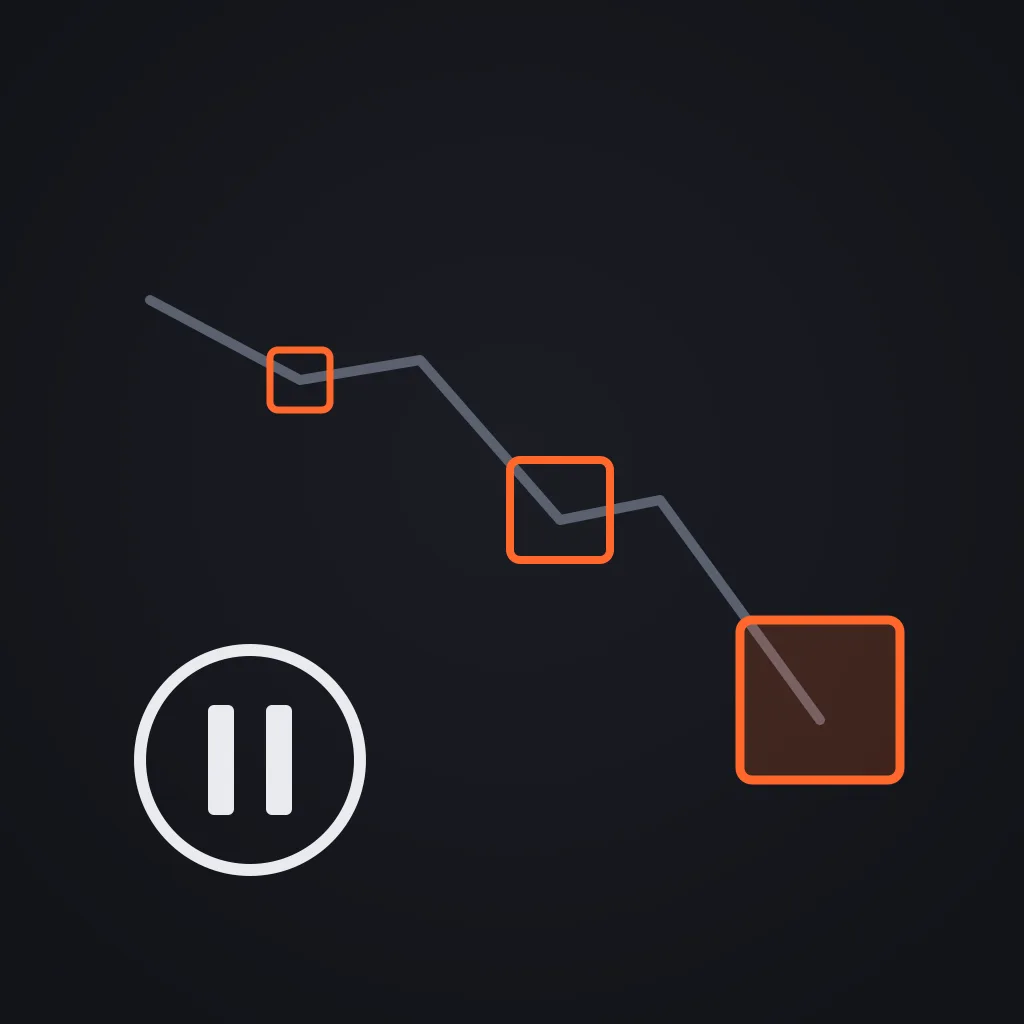
Revenge trading is opening a trade to win back money you just lost, rather than because your plan gave you a setup. It is one of the most common ways traders turn a normal losing trade into a losing day, and a losing day into a damaged account.
The good news is that it follows a predictable pattern, which means it can be spotted and limited with simple rules.
What revenge trading looks like
Most traders recognize the feeling: a stop gets hit, often on a trade that looked perfect, and the urge to get back in is immediate. The trades that follow tend to share a few signs:
- Bigger size than usual. "If I double the size, one winner gets it all back."
- Less time between trades. The next entry comes minutes after the loss instead of after a proper setup.
- Setups outside the plan. A pair you do not normally trade, a timeframe you do not use, or an entry without your usual confirmation.
- Moving or removing the stop. The fear of a second loss makes it tempting to give the trade "more room".
- Trading outside your session. Staying at the screen after your planned stop time because the day is red.
If two or more of these show up after a loss, you are probably revenge trading, even if it does not feel like it at the time.
Why it happens
Losses hurt more than equivalent gains feel good. Behavioral economists call this loss aversion, and it pushes people to take more risk to avoid locking in a loss. In trading, the account balance makes the loss concrete, and the market is always open for another attempt.
Add fatigue, frustration after a stop-out at the extreme of a move, or a run of losses, and the decision to trade stops being a decision about the market. It becomes a decision about your feelings.
Revenge trading is not a character flaw. It is a predictable reaction to losing under pressure, which is why the solution is mostly structural: rules that take the decision away at the moment you are least able to make it well.
The math of chasing a loss
Suppose you risk 1% per trade on a $10,000 account. A normal loss costs $100. Now follow a revenge sequence: after the first loss you double the size and lose again (−$200), then double once more and lose a third time (−$400). Three trades later the account is down $700, or 7%, instead of the $300 that three normal losses would have cost.
Recovery is harder than the drawdown suggests. After a 7% loss you need a gain of about 7.5% to get back to where you started; after a 20% loss you need 25%. Doubling size after losses makes the deep drawdowns much more likely, which is why it is so dangerous on a prop-firm account with a daily loss limit.
The position size calculator helps keep each trade at the same fixed risk, whatever happened on the last one.
Rules that stop revenge trading
The most effective rules are simple, written down before the session, and hard to argue with in the moment:
- A daily loss limit. For example, stop trading for the day after losing 2–3% of the account, or after a fixed number of losing trades.
- A cool-off after consecutive losses. After two losses in a row, step away for a set time, such as 30 minutes or until the next session.
- Fixed risk per trade. The size of the next trade does not depend on the result of the last one.
- A maximum number of trades per day. It caps the damage on days when nothing works.
- A pre-trade checklist. If the setup does not tick every box, there is no trade. Revenge trades almost never pass a checklist.
Write these rules where you can see them while trading. Some traders also set the daily loss limit inside their broker platform when it offers one.
An example rule set
Here is what a simple personal rule set might look like for a trader risking 0.5% per trade. Adjust the numbers to your own account and strategy:
- Risk per trade: 0.5% of the account, calculated before every entry.
- Daily loss limit: 1.5%. When it is reached, close the platform for the day.
- Two losses in a row: 30-minute break, then only A-grade setups for the rest of the session.
- Maximum trades per day: 4.
- No new trades in the last 30 minutes of the session.
The exact numbers matter less than having them written down before the day starts. A rule you invent in the middle of a losing streak is not a rule.
Use your journal to catch the pattern
Rules work better when you can see how often you break them. A journal, whether a spreadsheet or a forex trading journal app, turns a vague feeling ("I sometimes revenge trade") into a number you can track:
- Tag the mistake. Every trade you take to win back a loss gets a "revenge trade" mistake tag, even if it happens to win.
- Record your state of mind. Note how you felt before the entry: calm, frustrated, rushed. Patterns appear quickly.
- Look at the days, not just the trades. A P&L calendar shows whether your worst days cluster after an early loss, which is the classic revenge-trading footprint.
- Review weekly. Count the revenge trades and compare their result with your planned trades. For most traders the gap is large, and seeing it in numbers is a strong deterrent.
In Edgelog, each trade can carry a mood, an execution rating and mistake tags such as revenge trade, FOMO or overtrading, so the cost of each habit shows up beside your P&L; the trading psychology journal page explains how.
The Rulebook lets you save account-level rules such as a maximum number of trades per day or stopping after two consecutive losses, and reviews your synced trade history against them. It does not block trades; it shows you, with evidence, when a rule was broken. More on that in the trading rule tracker guide.
What to do right after a loss
A short routine helps more than willpower:
- Take your hands off the mouse and write one sentence in the trade notes: what happened, and was the trade within your plan?
- If the trade followed your plan, it was a good trade with a bad outcome. Nothing needs to be won back.
- Check your daily limit and your consecutive-loss rule. If either is hit, you are done for the session.
- If you continue, the next trade must pass the full checklist, at normal size.
When to take a longer break
If revenge trades keep showing up in your weekly review despite the rules, step back for longer: a day or two off, or a week on a demo account. Use the time to read through your tagged trades and screenshots.
Most traders find the same trigger behind most of them, such as a stop-out at the exact high, a news spike, or trading while tired, and that trigger can then get its own rule.
Revenge trading is closely related to overtrading, and the same journal habits help with both; see how to track trading psychology and stop overtrading.
Frequently asked questions
Is revenge trading the same as overtrading?
They overlap but are not the same. Revenge trading is driven by a recent loss and the wish to win it back. Overtrading is taking more trades than your plan allows for any reason, including boredom or excitement after a win. Revenge trading is one of the most common causes of overtrading.
How long should I stop trading after a big loss?
There is no universal answer, which is why the rule should be set before the session, not after the loss. Common choices are stopping for the rest of the session, stopping for the day once a daily loss limit is reached, or taking a full day off after breaking a rule. If the pattern repeats, a longer break helps more than a shorter one.
Can a trading journal stop revenge trading?
Not on its own. What a journal does is measure it: tagged revenge trades, the mood before each entry and the result of those trades compared with your planned ones. Seeing that number every week is what makes the rules feel worth following.
Summary
Revenge trading is trading to recover a loss instead of trading your plan. It usually shows up as bigger size, faster entries and setups you would normally skip. Fixed risk per trade, a daily loss limit, a cool-off after consecutive losses and a journal that counts revenge trades will not remove the urge, but they stop it from deciding your results.
This article is educational and is not financial advice. Past results do not guarantee future returns.