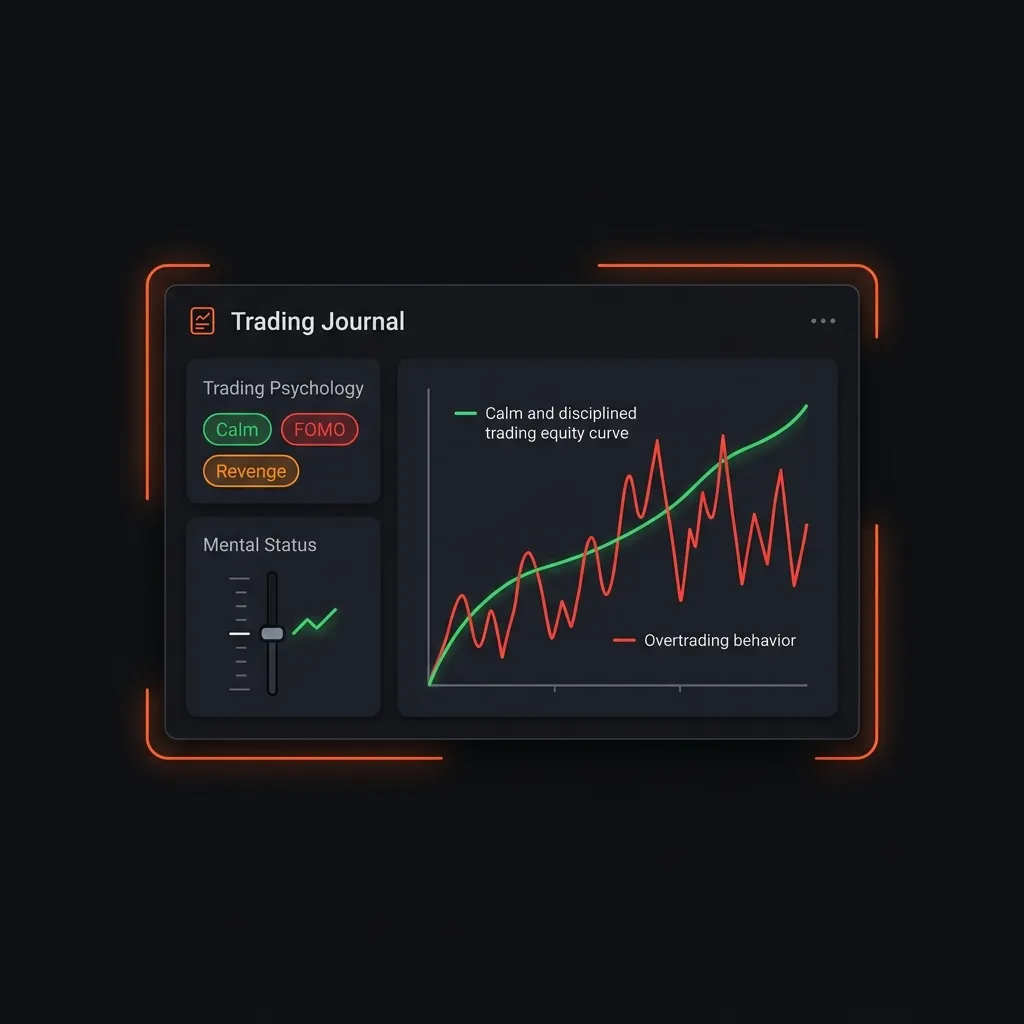
You're Not Overtrading Because You're Undisciplined
Here's what nobody tells you: overtrading isn't a character flaw. It's a feedback loop with no off switch — and the reason most traders can't break it is that they never actually look at the data behind their own behavior. You know you've taken too many trades this week. You just don't know why, or exactly when it started, or what emotional state you were in each time it happened. That's what tracking your trading psychology fixes. This post walks you through exactly how to do it — practically, not theoretically.
What Overtrading Actually Looks Like in Your Data
Overtrading has a signature. Once you start logging trades properly, it shows up fast.
The clearest signal is a spike in trade frequency that isn't matched by a spike in setup quality. You might normally take 8–12 trades a week on your London session strategy. Then one Wednesday, after two back-to-back losers, you suddenly have 22 trades logged before the New York close. Win rate on those extra 14 trades? Closer to 30% versus your usual 58%.
Other data patterns to watch for:
- Average holding time drops sharply — you're entering and exiting in minutes when your strategy calls for hours
- Trades cluster in short windows — six trades in 45 minutes, all in the same pair
- Risk-per-trade creeps up — not always, but revenge trading often comes with position sizing that breaks your own rules
- Losing streaks precede the cluster — look at what happened in the 2–3 trades before the overtrading spike
None of this is visible if you're just staring at your P&L. You need a log with timestamps, entry rationale, and emotional context — all attached to each trade.
The Missing Layer: Emotional Metadata
Most traders log what they traded. Almost nobody logs why they felt the urge to trade.
That missing layer is emotional metadata, and it's the difference between a trade log and a genuine trading psychology journal. Every entry should capture at least three things beyond the standard trade details:
- Pre-trade mental state — how were you feeling before you opened the chart? Anxious, calm, bored, frustrated after a loss, overconfident after a win?
- Setup confidence score — rate your conviction in the setup from 1–10. Be ruthless. A 6 out of 10 setup on a Friday afternoon is a very different trade than a 9 during peak liquidity.
- Trigger for entry — was it your actual system signal, or did you just feel like the price was going somewhere?
When you start filtering your trade history by these tags, patterns emerge fast. You might discover that every trade you took with a pre-trade state tagged "frustrated" lost money. Or that your setup confidence score drops below 6 whenever you're more than three hours into a session — and those low-conviction trades account for 80% of your drawdown.
That's actionable. That's something you can build a rule around.
How to Set Up a Psychology-Tracking System That You'll Actually Use
The system only works if you use it consistently, and you'll only use it consistently if it doesn't add ten minutes of friction to every trade. Here's a lightweight structure that covers the essentials:
Before the trade:
- Write one sentence: what's the setup and why does it qualify?
- Rate your mental state (1–5): 1 = distracted/emotional, 5 = calm and focused
- Rate setup quality (1–10): be honest
After the trade closes:
- Write one sentence: did price behave as expected? Did you manage it according to plan?
- One word for your emotional reaction: relieved, annoyed, indifferent, disappointed
- Flag it: did this trade follow your rules fully, partially, or not at all?
That's it. If you do this for four weeks, you'll have a dataset that most traders spend their entire careers without building.
Edgelog makes this significantly easier — the journal is built specifically for this kind of structured tagging, so you're not wrestling with a spreadsheet. You can attach mindset notes directly to each trade, tag by session or strategy, and then filter your analytics by those tags to see exactly where emotional decisions are bleeding into your performance.
Reading Your Psychology Data: What to Look For
Raw notes aren't enough. You have to review them — ideally weekly and monthly.
Set aside 20 minutes every Friday evening (or whenever your trading week ends) to look at your journal not as a trader, but as an analyst reviewing someone else's data. Ask yourself:
- Which trades had a mental state rating of 3 or below? What was the win rate on those versus 4–5?
- How many trades this week weren't triggered by a confirmed system signal?
- Is there a time of day or day of the week where rule-breaking clusters?
- What was happening externally — news event, bad day away from the charts, a big winner the day before?
A common finding: traders overtrade most aggressively on Tuesdays and Thursdays, not Mondays. Why? Monday they're cautious, still fresh. By Tuesday they have results (good or bad) creating emotional pressure. Knowing your specific pattern is the whole game.
You can explore more frameworks for this kind of self-analysis on the blog — there's a growing library of posts specifically for retail traders working through performance psychology.
Building Rules Directly From Your Psychology Data
Here's where tracking stops being journaling and starts being strategy. Once you've identified your overtrading triggers, you can write explicit rules to neutralize them.
Some examples based on common psychology patterns:
- "If my mental state pre-session is 2 or below, I can only take A-grade setups (confidence 8+). No exceptions."
- "After three consecutive losses in one session, I close the platform for the day."
- "I will not enter a trade more than four hours into an active session, regardless of how good the setup looks."
- "If I've already hit my weekly trade limit of 15, any additional trade requires a written pre-trade rationale of at least three sentences."
These aren't arbitrary rules invented from a YouTube video. They come directly from your data about your behavior. That's why they stick. Generic discipline advice doesn't stick because it has no personal accountability attached. Your own numbers do.
If you're also working through a prop firm challenge, this matters even more. Check the FAQ for how traders use Edgelog during funded account challenges — the psychology tracking is especially useful when you're under drawdown pressure and the temptation to overtrade spikes hard.
The Compounding Effect of Consistent Psychology Tracking
Here's what happens after 90 days of doing this properly. Your trade log becomes a mirror. Not just for overtrading — for all of it. The hesitation on valid setups. The early exits when you're up 1.5R and your target is 3R. The oversized positions on "sure things."
Traders who journal psychology don't just overtrade less. Their overall consistency improves because they've built genuine self-awareness about their process. Win rate matters, but process consistency is what drives long-term profitability. One trader using Edgelog found that simply tagging trades as "system" vs. "gut feel" for 60 days was enough to show that gut-feel trades accounted for 4% of their volume and 31% of their total drawdown. They didn't need a coach — they needed the data.
The habit itself also changes you. When you know you'll have to write down why you're entering this trade, you hesitate longer before clicking the button. That pause — even two seconds — is often enough to catch an emotional entry before it happens.
Start with the free psychology tagging system inside Edgelog and build from there. Pair it with the strategy playbook feature to codify what a valid setup actually looks like in writing, so you have something concrete to compare each trade against.
Stop Guessing, Start Logging
Overtrading doesn't stop because you decide to "be more disciplined." It stops when you have enough self-knowledge to recognize the moment it starts — and a system that makes that recognition automatic.
The traders who break the cycle aren't superhuman. They're just the ones who took their psychology as seriously as their chart setups. If you've read this far, you already know that's what's been missing. Start a free trading journal with Edgelog today, and give yourself 30 days of consistent psychology logging. The patterns will show up. What you do with them is up to you.