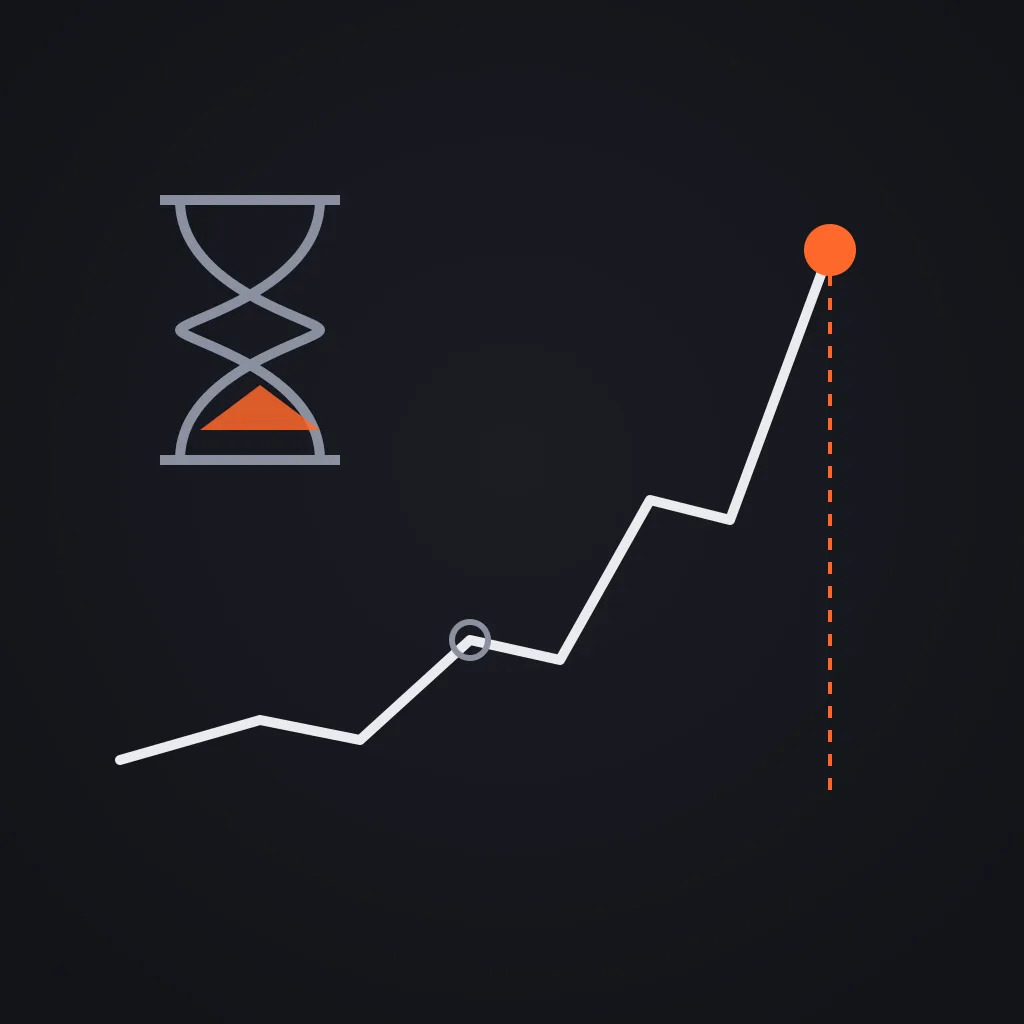
What is FOMO in trading? FOMO, the fear of missing out, is the urge to jump into a trade because price is moving without you. In trading it usually means entering late, after the move you were waiting for has already started, at a worse price and with a worse risk-reward ratio than your plan allowed. Almost every trader has felt it.
This guide explains what FOMO trading looks like, what it costs in numbers, and how to keep it out of your decisions.
What FOMO trades look like
- Chasing a breakout. Price breaks the level you were watching, runs 30 pips, and you buy at the top of the candle instead of waiting for a retest.
- Entering without your trigger. The setup is "almost there", so you enter before your confirmation appears.
- Trading what other people are trading. A pair is trending on social media or in a chat group, and you open a position without your own analysis.
- Re-entering a move you missed. You skipped the first entry, price moved, and now you take a worse one to be part of it.
- Oversizing on "sure things". A move that looks unstoppable feels safe, so the position gets bigger than normal.
What FOMO costs you
The main cost of a late entry is a worse risk-reward ratio. Suppose your plan was to buy a breakout at 1.1000 with a stop at 1.0970 and a target at 1.1060: 30 pips of risk for 60 pips of reward, a 1:2 trade. You miss it and buy at 1.1020 instead.
If you keep the same target and a stop below the same structure, you now risk 50 pips to make 40, a 1:0.8 trade. The breakeven win rate jumps from about 33% to about 56%. You can check numbers like these with the risk-reward calculator.
Late entries also tend to have lower win rates, because you are buying after the strongest part of the move, when early buyers start taking profit. A worse ratio combined with a lower win rate is how FOMO trades quietly drag down an otherwise sound strategy.
Why FOMO happens
FOMO is one of the most common topics in trading psychology, and the mechanism is simple. Watching price move without you creates the feeling that an opportunity is being lost, and losses, even missed ones, feel bigger than they are. Screens make it worse: every tick is visible, and social media shows other traders' winners but rarely their losses.
Traders under pressure to "make the month", or to pass an evaluation within a deadline, are especially exposed.
Underneath it all is usually a scarcity mindset: the belief that this move is the one that matters. In reality, liquid markets offer the same setups again and again. Missing one is a small cost; chasing it at a bad price can be a large one.
How to deal with FOMO
- Define your entry zone in advance. Write down the price range where the trade makes sense. If price leaves the zone, the trade is gone. No exceptions.
- Use orders instead of watching. Limit orders and alerts let you take the planned entry without staring at every candle.
- Make a "missed it" rule. For example: if price has moved more than half the distance to the target before you entered, skip the trade and wait for the next setup.
- Keep a written plan for the day. A short trading plan with the pairs, levels and sessions you will trade makes anything outside it easy to identify.
- Run a pre-trade checklist. FOMO entries rarely pass one.
- Reduce the noise. Mute trading chats during your session, and stop checking pairs that are not on your list.
A worked example: the missed breakout
You are watching GBP/USD for a break above 1.2700. Your plan: buy a retest of 1.2700 with a stop at 1.2675 and a target at 1.2750, 25 pips of risk for 50 pips of reward. Price breaks out while you are away from the screen and is already at 1.2730 when you return.
Chasing now means buying at 1.2730 with the same stop and target: 55 pips of risk for 20 pips of reward. Your "missed it" rule says price has already covered more than half the distance to the target, so there is no trade. Instead you set an alert at 1.2705 in case price returns for a retest.
If it does, you take the planned trade. If it does not, you have lost nothing.
Write the skipped trade in your journal too. Over time, a list of skipped chases is reassuring: most of them would have been poor trades.
Questions to ask before you click
- Is this trade in my written plan for today?
- Is price still inside my entry zone?
- Does the stop sit at a level where my idea is wrong, and does the target still give my minimum ratio?
- Would I take this trade if I had not just watched it move without me?
If any answer is no, the trade can wait.
FOMO outside the charts
FOMO is not only about price. It shows up as jumping on a coin because it is trending, copying a signal channel without checking the setup, or trading during high-impact news because "that is where the moves are". The same rule applies to all of them: if a trade did not come from your own plan, it does not belong in your account.
Your journal can show whether trades that came from outside sources make or lose money for you.
Track FOMO in your journal
The fastest way to cure FOMO is to see what it has cost you. In your journal:
- Tag every late or unplanned entry with a mistake tag such as "FOMO" or "chased price", whatever its result.
- Record your state of mind before each trade. "Rushed" and "afraid to miss it" are worth logging honestly.
- Note how far price had already moved from your planned entry when you got in.
- Once a month, compare the FOMO-tagged trades with your planned trades: win rate, average win, average loss and net result after fees.
Most traders find that their tagged FOMO trades lose money even when the rest of the strategy is profitable. That comparison is more convincing than any rule.
In Edgelog, mistake tags such as FOMO entry and overtrading, or tags you create yourself, sit on the same record as the trade result, mood and execution rating, so the review takes minutes; the trading psychology journal page shows how it works.
If you trade on MetaTrader 4 or 5, closed trades sync automatically through the free EdgelogSync Expert Advisor (see the MT4 trading journal guide), and other brokers can be imported from CSV or Excel. The trading bias journal guide covers how to record the bias you started the day with, which helps separate planned trades from impulsive ones.
Frequently asked questions
What does FOMO mean in trading?
FOMO stands for fear of missing out. In trading it describes entering a position because price is moving without you, rather than because your plan produced a setup. It usually shows up as late entries, skipped confirmation and larger size than normal.
Is it ever fine to enter a trade late?
Yes, if the trade still fits your plan. If price is still inside your planned entry zone, your stop still sits where the idea is wrong, and the target still gives your minimum ratio, a slightly late entry is just an entry. If any of those has changed, it is a different trade and should be judged as one.
How do I stop checking the charts all the time?
Replace watching with orders and alerts: set alerts at your levels, use limit orders for planned entries, and decide your trading hours in advance. Many traders find that FOMO and overtrading fall together once they stop watching every tick; see how to track trading psychology and stop overtrading.
Summary
FOMO in trading is the urge to chase a move you are not part of. It leads to late entries, worse prices and lower win rates, and it shows up clearly in a journal once you tag it. Decide your entry zone in advance, use orders and alerts, accept that missed trades cost nothing, and let your own numbers show you what chasing really costs.
This article is educational and is not financial advice. Past results do not guarantee future returns.