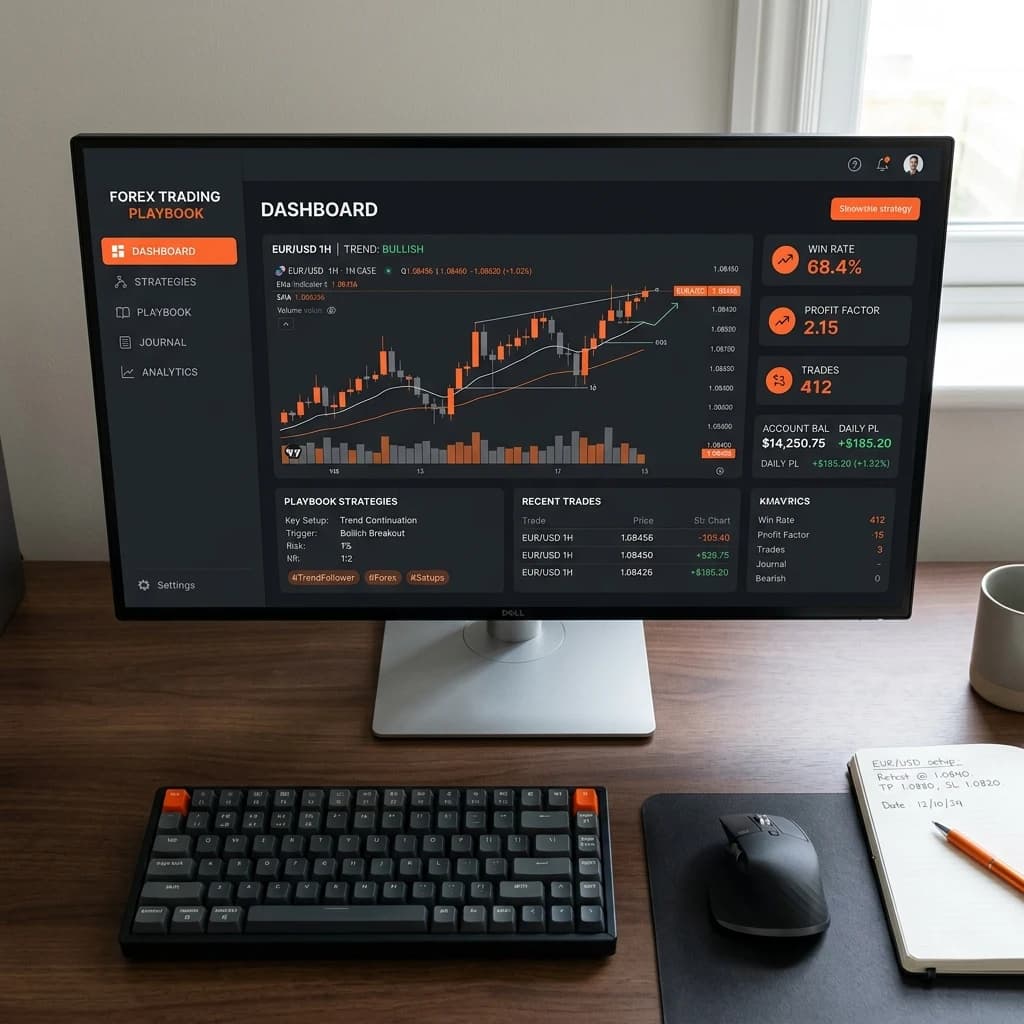
Most forex traders do not blow accounts because their strategy is broken. They blow accounts because they are a different trader every single day. Monday they follow the plan. Tuesday a news candle hits and they size up. Wednesday they revenge-trade after a stop-out. The strategy never gets a fair test because the person executing it keeps changing.
A trading playbook fixes that. Not by giving you new setups — by forcing you to write down exactly what you already do, so you have something concrete to hold yourself to when the market gets loud.
This guide covers what a playbook is, what goes inside one, and how to build yours from your actual trade data rather than theory.
What a Trading Playbook Actually Is
Think of it as a one-document operating manual for your trading. Before you open a chart, the playbook already has answers to every question the session might throw at you: which setups qualify, which do not, how much you risk, when you stop, and what state of mind you need to be in before you touch the keyboard.
It is not a course. It is not a framework you pay for. It is a written record of how you trade — refined over time using your own data.
A complete playbook covers six things:
- The exact setups you take, described precisely enough that someone else could execute them
- Entry and exit conditions with no room for interpretation
- Risk per trade expressed as a fixed percentage, not a feeling
- The sessions and pairs you trade and the reasons behind those choices
- Filters that keep you out of the market when conditions do not match your edge
- A short mental checklist you run before entering and after exiting every trade
Why Most Traders Never Build One
The honest answer: it feels slow. You want to be at the charts, not writing documents.
So most retail traders skip it and trust that they will recognise their setup when they see it. The problem is that "I'll know it when I see it" is not a rule. When you are up three trades and feeling sharp, your definition of the setup expands. When you are down and frustrated, it expands further. You start seeing setups everywhere — or nowhere.
Writing forces precision. You cannot write "I buy when it looks bullish" and leave it there. You have to commit: higher high on H4, break of the prior swing, 15-minute entry candle closes above the level, RSI not extended above 65. Once those words exist on paper, you either took a trade that meets them or you did not. There is no grey area to hide in.
Prop firm traders feel this pressure most clearly. A 5% max drawdown gives you almost no room to improvise. Your playbook is the thing that keeps you disciplined when a move is happening fast and your instincts are telling you to chase it.
What to Put in Your Playbook
1. Your Core Setup
Limit yourself to one or two setups. More than that and you are not specialising — you are just giving yourself permission to trade anything.
For each setup, document:
- Timeframe structure — for example, H4 for overall bias, 15M for the actual entry
- Market structure requirement — what the chart needs to look like before you even
consider an entry (e.g. a clear series of higher highs and higher lows)
- Entry trigger — the specific candle pattern, level break, or signal that starts the
trade
- Confirmation filters — conditions that must also be true (e.g. no red-folder news
within two hours, RSI below 60, spread within normal range)
If a stranger could read your setup description and execute it without asking you a single question, it is specific enough.
2. Risk Rules — Non-Negotiable
Write these as hard limits, not guidelines:
- Maximum risk per trade: 1% of current account balance
- Maximum daily drawdown: 3% — if hit, the session ends
- Minimum risk-to-reward ratio: 1:2 before any entry is valid
- No adding to a losing position under any circumstances
Pull these numbers from your own trade history, not from a content creator's settings. Your journal data will show you what drawdown your strategy actually produces and what risk level it can sustain without wiping out during a losing streak.
3. Session and Pair Filters
Not every hour of the forex day is worth trading. The London–New York overlap, roughly 13:00 to 17:00 UTC, produces the most volume and the cleanest price action for most strategies. Outside of that window, spreads widen, moves are thinner, and fakeouts are more common.
Pick two or three pairs and stay there. EURUSD, GBPUSD, and XAUUSD are common choices because they are liquid and have consistent personalities. The longer you trade the same instruments, the better you understand how they move around news, how often they sweep levels before reversing, and what a genuine breakout looks like versus a trap.
4. Pre-Trade and Post-Trade Checklists
A pre-trade checklist runs before you click. It confirms: setup is present, filters are clear, news is checked, risk is calculated, position size is set. If any item fails, no trade.
A post-trade checklist runs after the trade closes. It captures: did the setup meet every criterion, did you follow the plan exactly, what was your emotional state, and what — if anything — would you do differently.
This is the direct link between your playbook and your journal. The playbook defines the standard. The journal tracks whether you met it.
Build Your Playbook from Real Data
The most reliable playbooks are not written from theory — they are extracted from trade history. Here is the process:
- Export your last 50 to 100 trades from MT4 or MT5
- Tag each trade by setup type, session, pair, and result
- Calculate expectancy for each setup: (win rate × average win) − (loss rate × average
loss)
- Write rules only around the setups with positive expectancy
- Cut the setups with negative expectancy — regardless of how much you like them
Steps 2 and 3 are where most traders give up because doing it manually in a spreadsheet is tedious. Edgelog's MT4/MT5 EA syncs your trades automatically and the analytics dashboard breaks down win rate, profit factor, and drawdown by tag — so the data is already organised when you sit down to write your rules.
The Daily Routine That Makes It Work
A playbook sitting in a document folder helps no one. It has to be part of your daily process.
Before the session: Read your setup criteria. Open the economic calendar and mark any high-impact news events that fall within your trading window.
At the chart: Only take trades that pass every item on your checklist. If one condition is missing, skip the trade. One missed trade costs you nothing. One trade taken outside your rules can cost you the whole session.
After the session: Log every trade — entries taken, setups skipped, and why. Note your emotional state honestly. If you deviated from the plan, write down what triggered it.
Weekly: Review your journal. Are your results tracking with your historical expectancy? Are you drifting from your rules in any consistent way? Update the playbook if the data suggests a genuine improvement — not just because you had a bad week.
Edgelog includes a mindset journaling section specifically for this routine, so your psychology notes sit alongside your P&L data rather than in a separate notebook that never gets opened.
Four Mistakes That Kill Playbooks
Too many setups. One solid setup you understand deeply will outperform five setups you sort of recognise. Complexity creates decisions. Decisions under pressure create errors.
Rules that are too vague. "Good risk-reward" is an opinion. "Minimum 1:2, stop placed below the last confirmed swing low on the entry timeframe" is a rule. Every item in your playbook should pass the same test: could two different traders read this and reach the same conclusion?
Building it once and forgetting it. Markets shift. Volatility regimes change. What worked in Q1 may underperform in Q3. Set a monthly calendar reminder to review your playbook against the most recent 30 days of journal data.
Leaving out the mindset section. Your technical setup can be perfect and the trade can still fail because you sized up after a winning streak or hesitated after a losing one. Document your emotional state before every trade. Over time the patterns become visible.
Start Small, Refine as You Go
Your first playbook does not need to cover everything. Start with one setup, three risk rules, and a five-point pre-trade checklist. Trade it for 30 days and log every session.
At the end of those 30 days you will have real data telling you whether the setup works, where you are deviating, and what to adjust. That one month of disciplined data is worth more than a year of unlogged trading where you are essentially starting from scratch every week.
The traders who build durable edges are not the ones with the most indicators or the longest screen hours. They are the ones who know precisely what they are looking for, trade only that, and have the numbers to prove it is working.
Start journaling free with Edgelog and build your playbook where your trade data already lives.