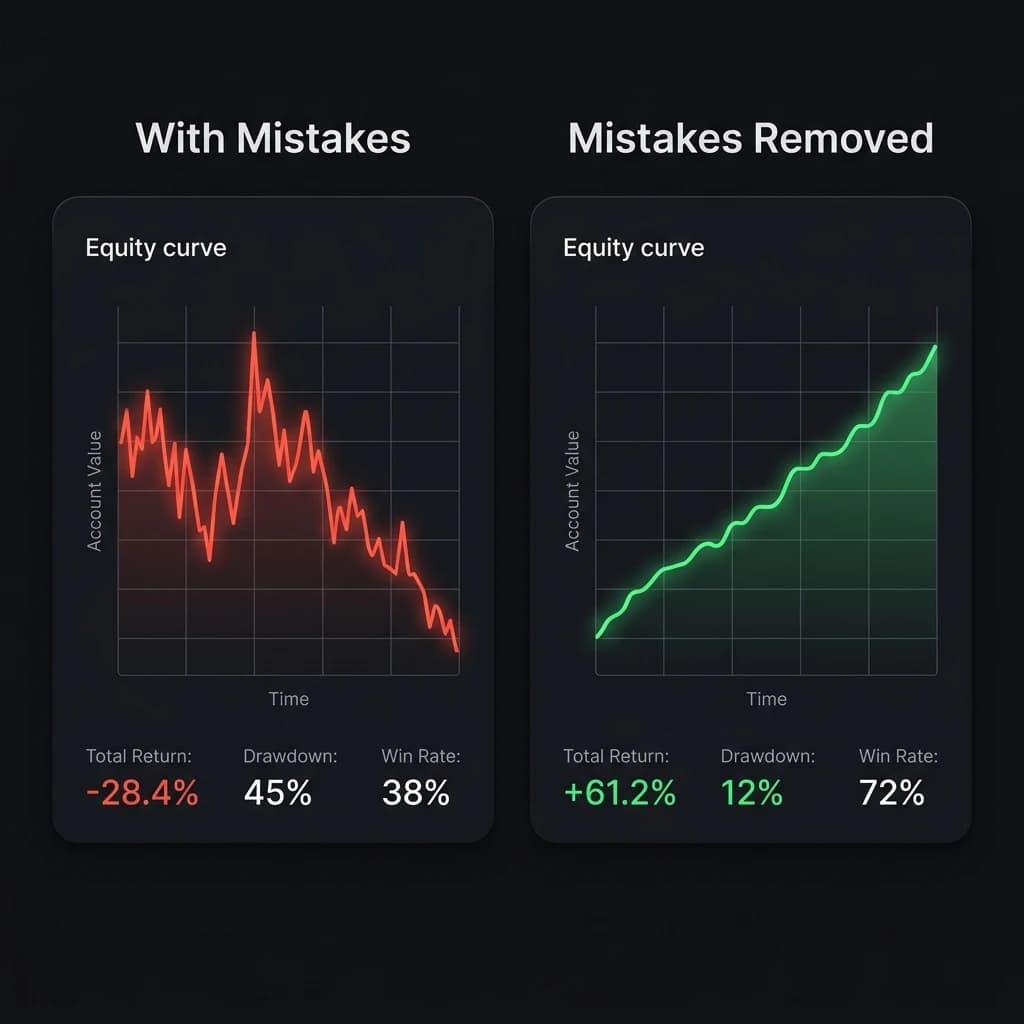
Most traders spend hours optimizing their entries and exits. They backtest, they tweak, they hunt for a better indicator. Meanwhile, a quiet leak is draining their account every single week — trades they took against their own rules, sizes they knew were too big, setups they entered out of boredom or revenge. That's your Mistake Cost. And until you measure it, you can't fix it.
What Is the Mistake Cost Metric?
The trading mistake cost metric is simple: it's the total realized P&L impact of trades you yourself identify as rule violations or emotional errors — measured over a defined period.
It's not about losing trades. Losing is part of trading. It's about losing on trades you knew, in the moment or immediately after, were wrong. The setup didn't qualify. Your position size broke your own risk rules. You moved a stop loss. You re-entered immediately after getting stopped out. You know the list.
The formula looks like this:
Mistake Cost = Sum of P&L from all self-tagged "mistake" trades over a period
If you took 60 trades last month and tagged 12 of them as errors — ranging from a $40 loss on a boredom trade to a $210 blowout from a doubled-up revenge position — your Mistake Cost might be -$680 for the month. That's not an abstract number. That's money you gave back on trades your own system would have told you to skip.
Why This Metric Matters More Than Win Rate
Win rate tells you how often you're right. Profit factor tells you your edge. Neither tells you how much of your performance is self-inflicted damage.
Here's the uncomfortable truth: a lot of traders are actually running a profitable strategy underneath a layer of costly mistakes. They see a mediocre month and assume their system is broken. They start tweaking entries, changing indicators, going down a rabbit hole. But the system isn't broken. The execution is.
Say your strategy produced +$1,200 in valid trades last month. Your Mistake Cost was -$850. Your net result: +$350. You're frustrated. You feel like you're grinding for nothing. But the real headline is that your edge made $1,200 — and your habits cost you $850. Fix the habits, not the strategy.
That reframe changes everything about what you work on next.
How to Start Tracking Mistake Cost in Your Journal
You don't need a complex system. You need a consistent tagging habit. Here's a practical process:
- Define your mistake categories before you start tagging. Vague labels don't help. Be specific: "No HTF confluence," "Over-sized position," "Revenge trade," "Late entry after missing original setup," "Moved stop loss to avoid a loss." Write these down in your strategy playbook.
- Tag trades as close to execution as possible. Don't wait until your weekly review. Tag the trade within an hour of closing it, while the reasoning is still fresh. Waiting three days means you'll rationalize the bad ones.
- Log a one-line note on every mistake trade. Not an essay — just enough to capture what happened. "Entered GBPUSD because I was bored waiting for EUR setup. No valid signal." That note is worth more than a week of backtesting.
- Calculate your Mistake Cost weekly. Pull all trades tagged as mistakes, sum the P&L, and record the number. Track it over time. You're looking for a trend, not perfection.
- Separate it from overall P&L in your review. You want two numbers side by side: what your strategy made (valid trades only) and what mistakes cost you. That gap is your improvement target.
If you're using Edgelog, you can tag trades directly after sync from your MT4/MT5 EA, add notes from your phone before you close the chart, and filter your analytics by tag — so calculating Mistake Cost takes about two minutes at the end of the week, not an hour of spreadsheet work.
The Most Expensive Mistake Categories (And How to Spot Yours)
Not all mistakes cost the same. Across traders who journal consistently, a few categories tend to cause outsized damage:
- Revenge trading. You lose a clean setup, feel the sting, and immediately re-enter. Often at higher size. This single behavior can turn a -1R loss into a -3R or -4R hole in one session. Track revenge trades separately — you'll be shocked how few of them you need to eliminate to dramatically improve your numbers.
- Moving stop losses wider. You place a stop, price approaches it, you move it "just this once." This turns defined-risk trades into undefined-risk trades. One of these going wrong can equal five normal losses.
- Over-sizing on high-conviction setups. You love the trade, you double the size. When it loses — and sometimes it will — the P&L damage is disproportionate. High conviction is not a risk management substitute.
- FOMO entries after a missed setup. The original setup triggered, you missed it, you chase. You're now entering at a worse price with a stop that doesn't make structural sense. These trades almost never pay out at the original R:R.
Sound familiar? Most traders recognize two or three of these immediately. The goal isn't to be ashamed of them — it's to measure them so you know which one is costing you the most money. Fix that one first.
Setting a Mistake Cost Budget
Here's a practical target: keep your Mistake Cost below 10% of your gross trading revenue in any given month. If your valid trades make $1,000, you're allowed $100 in mistake losses before you trigger a serious review of your process.
That sounds harsh, but it's not about perfection. It's about having a threshold that forces honesty. When Mistake Cost creeps toward 30%, 40%, or 50% of gross — which happens more than traders admit — something systematic is going wrong. You might be trading too many sessions in emotional states. You might be oversizing consistently. You might be in a drawdown spiral that's wrecking your judgment.
The budget gives you a concrete trigger for a process review, not a vague feeling that "last month was rough."
Also worth tracking: your Mistake Frequency Rate — the percentage of total trades that were tagged as mistakes. If 20 out of 60 trades are mistakes, that's 33%. That's a very different problem than 5 out of 60. High frequency often points to boredom trading or poor session selection. High cost-per-mistake with low frequency usually points to position sizing or stop management issues. These need different solutions.
Using Mistake Cost Data in Your Weekly Review
Raw numbers are only useful if they drive decisions. In your weekly review, ask yourself three questions:
- What was my Mistake Cost this week, and how does it compare to the previous four weeks?
- Which single mistake category caused the most damage?
- What's one concrete rule change or process adjustment I can make before next week?
The third question is the most important. Don't just identify the problem — attach an action. If revenge trading cost you $340 this week, the action might be: "I will close the platform for 30 minutes after any stopped-out trade before I'm allowed to re-enter the market." Specific, testable, and simple enough to actually follow.
Over at the Edgelog blog, you'll find other review frameworks that pair well with Mistake Cost tracking — including how to build a pre-trade checklist that catches errors before they happen, not after.
What Happens When You Actually Fix This
Here's the realistic payoff. Traders who consistently track and reduce their Mistake Cost don't suddenly become perfect. But they do something more valuable: they stop sabotaging a strategy that was already working.
A 30% reduction in Mistake Cost — not elimination, just reduction — can be the difference between a breakeven month and a profitable one, or between a struggling prop firm challenge and a funded account. The edge was always there. You just kept stepping on it.
Check the FAQ if you want to understand more about how Edgelog handles trade tagging and analytics before you commit. And if you're already sold on the concept, the pricing page confirms what you probably heard — it's free.
The best time to start tracking your Mistake Cost was your first month of trading. The second best time is right now. Start a free trading journal with Edgelog, tag your next ten closed trades honestly, and you'll already know more about your real performance than most traders figure out in years.