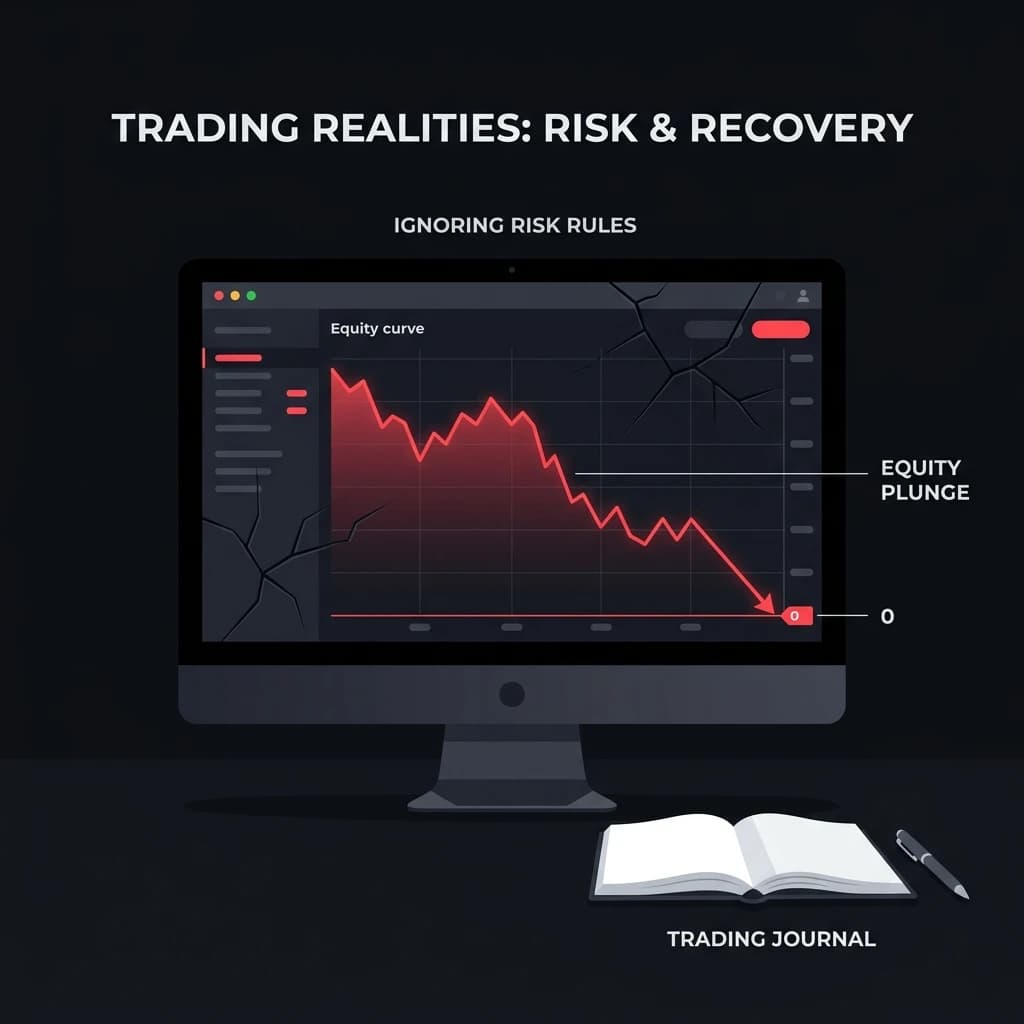
Why Most Traders Blow Up (It's Not What You Think)
Here's a hard truth: you can have a 60% win rate and still blow your account. Winning trades don't protect you. Your position sizing does. Your rules do.
Most retail traders lose not because their analysis is wrong, but because they have no structured response to being wrong. One bad week turns into revenge trading. A drawdown becomes a panic. Before long, a $5,000 account is sitting at $800 and the trader is telling themselves it was bad luck.
It wasn't luck. It was the absence of three specific risk management rules — rules that professional traders follow whether they're up on the month or down. If you trade forex or crypto and you want to actually stay in this game, these aren't optional. They're the floor.
Rule 1: Never Risk More Than 1–2% Per Trade
This is the rule most traders know but almost none actually follow under pressure.
When you're confident in a setup, 5% feels reasonable. When you've just taken two losses in a row, 4% on the next trade feels like "getting back to breakeven faster." That logic is how accounts die.
The math behind the 1–2% rule isn't glamorous, but it's protective. If you're risking 2% per trade and you hit a 10-trade losing streak — which absolutely happens, even to good traders — you're down roughly 18%. Painful, but survivable. Now imagine risking 10% per trade across that same streak. You're wiped out by trade 10.
A few things this rule forces you to do correctly:
- Calculate your position size before entering, not after
- Place your stop loss at a technically valid level, then size accordingly
- Detach your ego from the size of the trade
The practical way to implement this: decide on your account risk percentage, set a hard stop loss, and use a position size calculator every single time. No exceptions, no "just this once."
If you're using MT4 or MT5, you can automate the logging of every trade — including the risk taken — directly into Edgelog via the Expert Advisor sync. That makes it easy to look back and see if your actual risk per trade matches what you think you're risking. Most traders are shocked when they check.
Rule 2: Set a Daily and Weekly Drawdown Limit — and Actually Respect It
One of the fastest ways to destroy an account is to keep trading when you're in the wrong headspace. And the clearest signal that you're in the wrong headspace is a daily drawdown above 3–5%.
Prop firm traders know this well. Most funded account challenges cap daily drawdowns at 4–5% specifically because the data shows that trading beyond that threshold in a single session almost always makes things worse, not better. Discretionary decisions made in a loss spiral are almost never rational.
Here's what a daily drawdown limit actually does: it converts an emotional problem into a procedural one. Instead of asking yourself "should I keep trading?" after three bad trades, the answer is already decided. You're done for the day.
A practical framework looks like this:
- Set your daily loss limit at 3–5% of account equity (align with your prop firm rules if applicable)
- Set your weekly loss limit at 8–10% — enough room to trade through variance, not enough to destroy the account
- When either limit is hit, close the platform and do something else
The hardest part isn't knowing the rule. It's having a system that holds you accountable to it. That's where a trading journal becomes genuinely useful — not just as a log, but as a mirror. When you record your P&L daily and tag your mental state alongside each session, patterns emerge fast. You'll see that your worst weeks almost always started with a Tuesday where you blew your daily limit and kept trading anyway.
Check out the blog for more on how traders use psychology tagging to catch these patterns before they become expensive habits.
Rule 3: Correlate Your Positions — or Pay the Price
Most beginner traders think they're diversified because they have five open trades. They're not — if four of those trades are long USD pairs, they've essentially put everything on one directional bet.
Correlated positions are a silent account killer. You enter EURUSD long, GBPUSD long, AUDUSD long, and NZDUSD long simultaneously. You feel diversified. Then a strong NFP number hits, the dollar rips, and all four trades stop out at the same time. That's not four small losses. That's one large loss wearing four different names.
The fix is straightforward once you're paying attention:
- Group your open trades by underlying exposure (dollar direction, risk-on/risk-off sentiment, correlated assets)
- Treat correlated pairs as a single combined position for risk calculation purposes
- If you want to trade multiple correlated pairs, reduce size on each so total exposure stays within your overall risk rules
A simple example: if your max risk per trade is 1.5%, and you want to take three positively correlated setups, consider sizing each at 0.5% instead of 1.5%. Your total exposure stays at 1.5% combined rather than ballooning to 4.5% on what is functionally the same trade.
This kind of position-level thinking is exactly what the analytics inside Edgelog are built for. When you tag your trades by currency pair, session, and setup type, it becomes easy to spot over-concentration in your equity curve — not as a theory, but in your actual trade history.
How These Rules Work Together
These three rules aren't independent. They form a system.
The 1–2% rule manages your single-trade exposure. The daily and weekly drawdown limits manage your session-level behavior. The correlation rule manages your portfolio-level risk. Skip any one of them and the other two can still fail to save you.
Sound familiar? A lot of traders have two of the three locked in and keep wondering why they still blow up occasionally. It's almost always the missing third rule doing the damage.
If you're taking prop firm challenges specifically, these rules line up almost exactly with the risk parameters most firms set — and for good reason. The firms that fund traders want to see that you have procedures, not just instincts. Documenting your adherence to these rules in a trading journal is also one of the best ways to build the habit before the funded account pressure turns up.
How to Actually Stick to These Rules
Knowing the rules and executing them under pressure are two different skills. Here's what actually helps:
- Write your rules down before you open the platform — not as a mental note, a physical document or a pinned journal entry
- Review your last 20 trades weekly — look at actual risk taken, not intended risk
- Use your journal to flag rule violations, not just losing trades. A winning trade that broke your rules is still a bad process trade
- Track your psychological state alongside your P&L — stress, overconfidence, and impatience show up in the numbers before you consciously notice them
The traders who survive long-term aren't necessarily the ones with the best entries. They're the ones with the best responses to adversity — and that's a skill you build through honest self-review, not more screen time.
For common questions about journaling workflows and trade tracking setup, the FAQ is a good starting point.
The Cost of Skipping This
One blown account costs you more than money. It costs you the time to rebuild, the psychological damage of starting over, and often the confidence to trust your own analysis again. Some traders never come back from it.
Three rules — position sizing, drawdown limits, correlation management — are genuinely all it takes to prevent the kind of catastrophic loss most traders experience at least once. Not to guarantee profits. Not to make you a better analyst. Just to keep you solvent long enough to actually develop an edge.
The traders with multi-year track records aren't smarter than you. They just stopped giving the market the chance to end their career in a single bad week.
---
If you want to start tracking your risk management in real time — not in theory, but in your actual trade history — start a free trading journal with Edgelog today. Connect your MT4 or MT5 account, tag your trades, and see exactly where your risk discipline holds and where it breaks down. That's where real improvement starts.