You're Probably Trading the Wrong Hours
Most traders lose more money between 8 PM and midnight than they'll ever admit. Not because the markets are rigged against them after dark, but because they've never actually looked at the data. They trade whenever they're free — after work, on lunch breaks, during slow Sunday sessions — without any idea whether those hours are quietly draining their account.
Here's the uncomfortable truth: your trading edge doesn't exist in the abstract. It exists at specific times, in specific session conditions, when the market structure aligns with how your brain actually works. Find those hours and protect them. Trade outside them and you're just gambling with better charts.
This guide walks you through exactly how to analyze your session performance, identify your peak trading hours, and build a schedule that actually supports your strategy.
Why Session Timing Matters More Than Most Traders Realize
Forex runs 24 hours a day. Crypto never closes. That sounds like freedom — it's actually a trap.
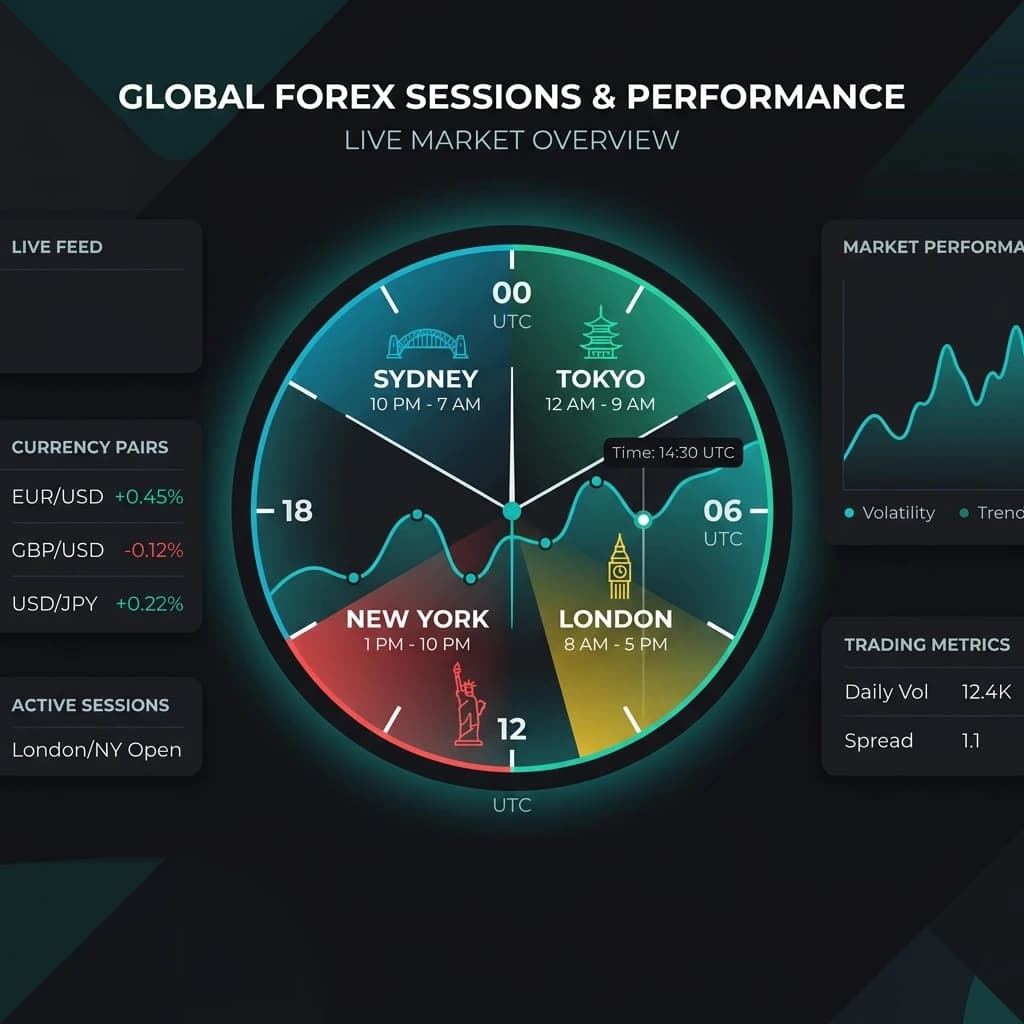
Volume, volatility, and spread behavior change dramatically across the four major forex sessions: Sydney (10 PM–7 AM GMT), Tokyo (midnight–9 AM GMT), London (8 AM–5 PM GMT), and New York (1 PM–10 PM GMT). The London–New York overlap from 1–5 PM GMT is where roughly 70% of daily forex volume concentrates. Spreads tighten, liquidity deepens, and clean institutional moves become more readable.
Crypto adds another layer. BTC/USD tends to see sharper moves during U.S. market hours, especially around the New York open and close. But it also reacts to Asian sentiment — so a slow Sunday afternoon in your timezone might actually be peak volatility for a BTC scalper watching Asian institutional flow.
The session that fits your strategy depends on three things:
- Your actual availability (not your ideal schedule — your real one)
- How your strategy performs under different volatility regimes
- When you personally make better decisions
That last one matters more than most people acknowledge. Some traders are sharper at 6 AM before the noise starts. Others need an hour to warm up and trade best mid-morning. Your psychology has a rhythm, and your data will show it — if you're recording it.
How to Pull Session Performance Data from Your Journal
If you're logging trades properly, this analysis is straightforward. If you're not logging them, you can't do it at all — which is one of the core reasons a structured journal pays for itself immediately.
Here's the process:
- Export your trade history — Pull at least 3 months of data. Fewer trades than that and small sample sizes will produce misleading patterns.
- Tag each trade by session — London, New York, Asia, or overlap. If your journal doesn't do this automatically, add a custom tag at the entry.
- Sort by hour opened — Group trades by the hour they were entered, not when they closed.
- Calculate per-session metrics — Win rate, average R: R, profit factor, and max drawdown per session. Don't just look at win rate. A 60% win rate during London means nothing if your average winner is 0.5R and your average loser is 1.5R.
- Look for outliers — Which single hour of the day has your worst profit factor? Which has your best? The gap is often shocking.
In Edgelog, session tagging is built into the trade entry flow, and the analytics dashboard breaks down performance by time of day automatically once you've synced your MT4/MT5 history. You're not doing this manually in a spreadsheet — it just surfaces.
What the Numbers Usually Reveal
When traders actually run this analysis, a few patterns show up consistently.
Overtrading during slow sessions. The Asia session is low-volatility by design for most major pairs. Traders bored with the London session staying open end up taking B-grade setups during Tokyo hours. The trades look fine on a chart, but the stats tell a different story — lower win rates, tighter profit factors, more scratch trades.
The pre-news trap. Trades opened in the 30 minutes before a major news release (NFP, CPI, FOMC) carry a different risk profile than everything else. Many traders don't separate these, so a few blowup trades contaminate their London session stats and make it look worse than it is.
A hidden golden hour. Almost every trader who does this analysis finds one — an hour window where their setup hit rate is noticeably higher than average. For a lot of London session traders, it's 8–9 AM GMT, right at the open before retail noise muddies the structure. For New York traders, it's often 1:30–2:30 PM GMT, after the initial open volatility settles.
Fatigue trading. Night-session losses often cluster in the last 90 minutes before a trader goes to bed. Decision quality drops, discipline around stop placement gets looser, and revenge trades appear after hours. Your data will show this as a specific hour range where your expectancy turns negative.
Sound familiar? You won't know for certain until you pull the numbers.
Building Your Peak Hours Schedule
Once you've identified your best and worst performing windows, act on them deliberately.
Start by protecting your A-sessions. If London open 8–10 AM GMT is where you make 80% of your net profit, that window is sacred. Calendar it. Don't schedule calls. Don't trade anything else in a distracted way during it.
Then — and this is harder — restrict your C-sessions. If the Asia session consistently produces negative expectancy for your strategy, stop trading it. Not "trade it more carefully." Stop. The discipline to close your platform and go do something else is genuinely a trading skill.
A practical framework:
- A-session: Your top 1–2 time windows by profit factor. Trade full-size, full focus.
- B-session: Breakeven to slightly positive. Trade reduced size or use it for practice entries.
- C-session: Negative expectancy. No live trading. Use it for review, journaling, or chart study.
Re-run this analysis every 90 days. Market structure shifts seasonally, and your strategy's edge in the London–New York overlap in Q1 might look different in Q3 when summer liquidity dries up.
For more on structuring your review process, check out the blog — there's a lot more on trade review frameworks and habit-building for consistent traders.
Common Mistakes When Analyzing Session Data
A few things will skew your results if you're not careful.
Ignoring sample size. If you only have 12 trades during the Tokyo session, you can't conclude them. You need at least 30 entries per session before the stats mean anything. Note the gap and fill it with deliberate observation, not a trading decision.
Conflating strategy types. If you trade breakouts during London and mean-reversion during Asia, comparing their stats directly tells you nothing useful. Segment by strategy first, then by session.
Not accounting for news events. Filter out the 30 minutes around high-impact news events as a separate category, at least initially. Otherwise, a handful of newsflow disasters will distort your whole session analysis.
Treating the data as permanent. Your peak hours today may not be your peak hours in six months. Seasonal patterns, a new job with different hours, or a strategy adjustment all shift the picture. This is an ongoing process, not a one-time exercise.
For answers to common questions about how to structure your journaling practice, the FAQ covers a lot of the basics on getting started with performance tracking.
The Edge Is in the Data You've Already Generated
You've already traded hundreds or thousands of hours. The information you need to trade better is sitting in your trade history right now — you just haven't organized it in a way that makes it visible.
Session performance analysis isn't advanced quantitative trading. It's basic pattern recognition applied to your own behavior. Which hours do you focus well on? When does your strategy actually fire cleanly? When do you take low-quality setups because you're bored, tired, or emotionally reactive?
Your data knows. You just have to look.
Edgelog was built specifically so that this kind of analysis is automatic rather than a weekend project in Excel. Connect your MT4 or MT5 account via the Expert Advisor, let your history sync, and the session breakdown is there in your analytics dashboard. No formulas, no pivot tables, no manual tagging unless you want it.
Stop trading the hours that drain you. Find the window where your edge is real, protect it, and let everything else go. That single shift — schedule discipline based on actual data — is one of the highest-leverage improvements most retail traders can make.
Start a free trading journal and run your first session analysis today. The data's probably going to surprise you.